Stronger readers achieve more.
A self-paced, supplemental reading program for every middle school learner, from struggling to advanced, with English and Spanish audio.

Every middle schooler works at their own level and pace.
- 9reading levels
- 270passages
- 4,320questions
- 50 states + DCreading standards built in
From placement test to measured growth
A supplemental reading program for middle schoolers below, on and above grade level. Every student reads at their own level and proceeds at their own pace, in a classroom or in a home school.
A placement test finds each student's level
Passages start at a grade 3 reading level and climb to grade 11, and the test stops when they get too hard.
Students read at their level, with key words taught first
Fiction and nonfiction, many with a second source. Teachers can turn on English audio, or Spanish text and audio, for any student.
Questions aligned to your state's reading standards
Passage questions and reports follow your state's reading standards, in all 50 states and DC. Beneath them are Reading Anchor Standards R.1 to R.9, at every level, except where a state has no matching standard.
Every mistake becomes a lesson
A wrong answer brings a hint and lights up the evidence, and a second try earns partial credit.
A Skill Booster when a strand needs work
A practice passage pitched a little easier, with questions only on the strands that need attention.
The Challenge ends every level
A real role, several sources, and a decision to defend with evidence. Then the next level opens.
Every standard reported, and growth measured
Reports score each strand and standard under your state's names and codes, and track progress from level to level. A second benchmark measures overall growth.
Every mistake becomes a lesson
A wrong answer brings an instant hint and lights up the evidence, so students go back to the text and try again. Pick a wrong answer to see it.
Amira Haddad kept a green notebook that nobody else in the chess club bothered to open. The pages were meticulous. Every game she had ever lost to Beatriz Salas was recorded there, move by move, with a short note about where the position had turned against her. Nineteen losses. Amira had studied all nineteen the way other students studied for finals.
Bea played board one and Amira played board two. That order had held since sixth grade. Bea was not arrogant about it, which somehow made it worse. By the middle of eighth grade, though, Amira could anticipate almost everything Bea liked to do: the moves she favored early, the pieces she was quick to trade, and the patient way she played when her time ran short.
According to the passage, how many games had Amira lost to Bea?
Start at the right level and climb from there
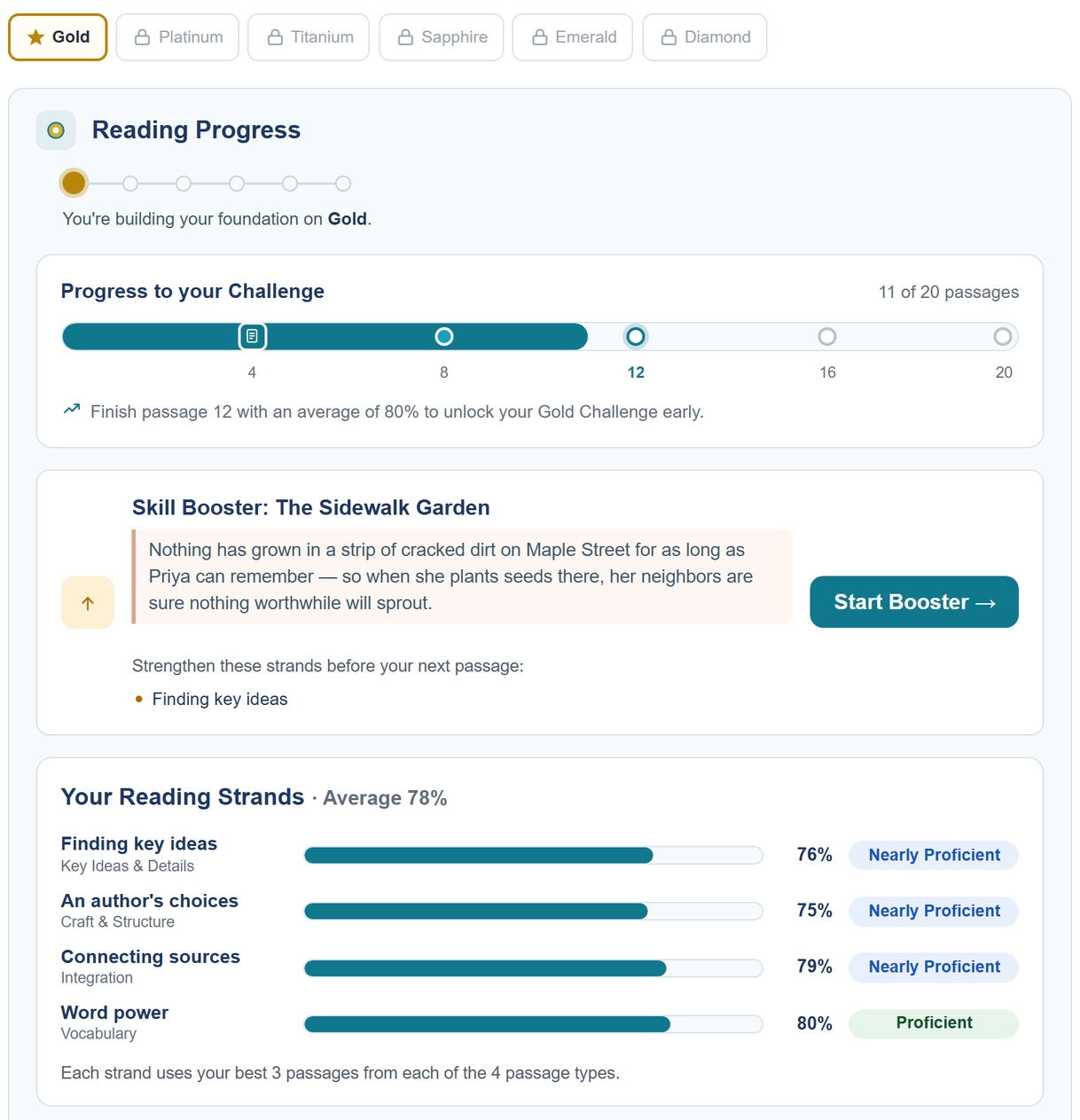
Each student's dashboard shows where they stand and what to do next.
- One clear next step. The next passage waits with a Start Passage button, so no one has to ask what to do.
- Progress they can see. A bar counts passages to the level's Challenge, and students who do well reach it early.
- A score on every strand. Four reading strands, each with a score, and a Skill Booster appears when one needs work.
- Their own reports, one click away. Passage History, and a Certification Report with every strand and standard.
Students see a level's name, never a grade, so the screen never tells anyone they are reading below grade level.
Apply2Succeed has 180 core passages, 90 Skill Booster passages, and a Challenge activity at the end of each level.
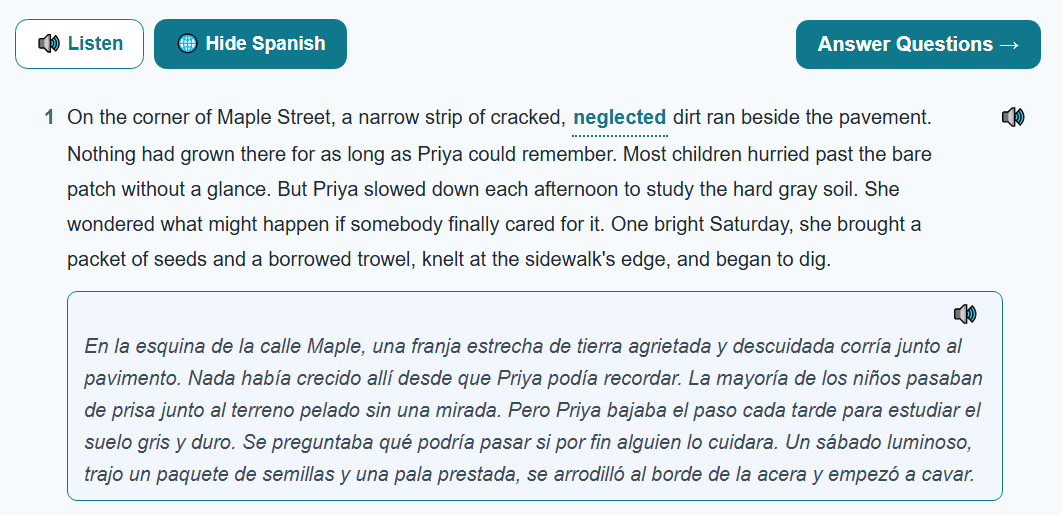
Read and listen to every passage in English or Spanish
Teachers can turn on English audio, or Spanish text and audio, for any student who needs it.

Apply what you’ve learned
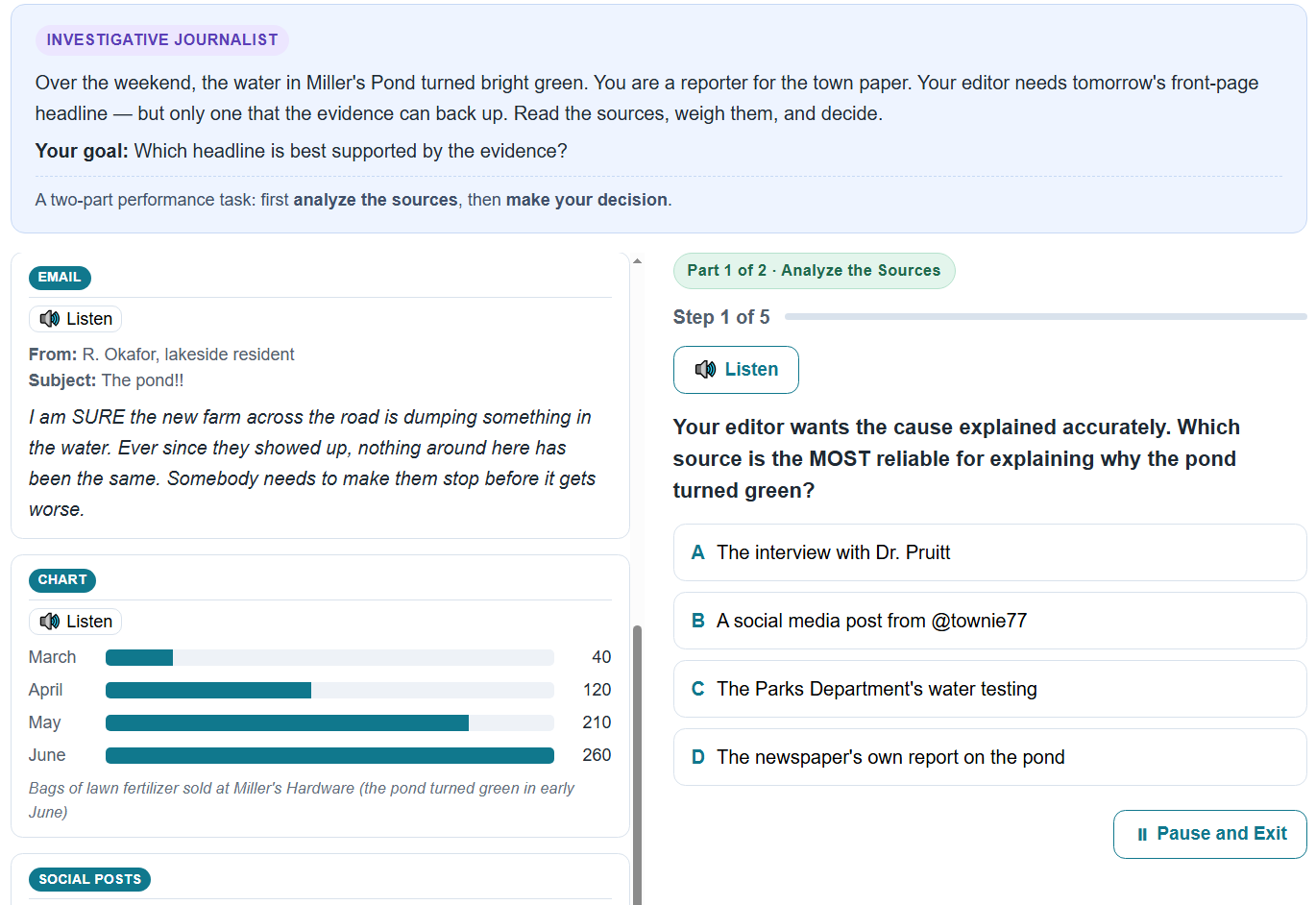
Each level ends with a Challenge: take on a real role, weigh the evidence, and make a decision you can defend. Every Challenge gives you five sources to work from, such as an article, a chart, an email and social posts.

Built for a real classroom
- Set up in one sittingA short video walks you through it: create a class, add your students and print their sign-in cards. It runs in a web browser, so there is nothing to install and no training day to schedule.
- Each student at their own level and paceEven in a class of 35, each student reads at their own level and moves on when ready. There are no reading groups to manage.
- Nothing to plan, nothing to gradeThe placement test finds each student's level, and the program guides what comes next. Every answer is scored and saved as it's given, so the reports build themselves and a student never loses their place.
- A mistake isn't a dead endA wrong answer brings a hint and another try for partial credit, so a struggling reader still finishes with something to show.
- Reading that suits their ageEven at a grade-3 reading level, the passages are written for middle schoolers, not younger children.
- A letter home, already writtenThe Progress Letter describes each student's progress in plain sentences, ready to print for families.
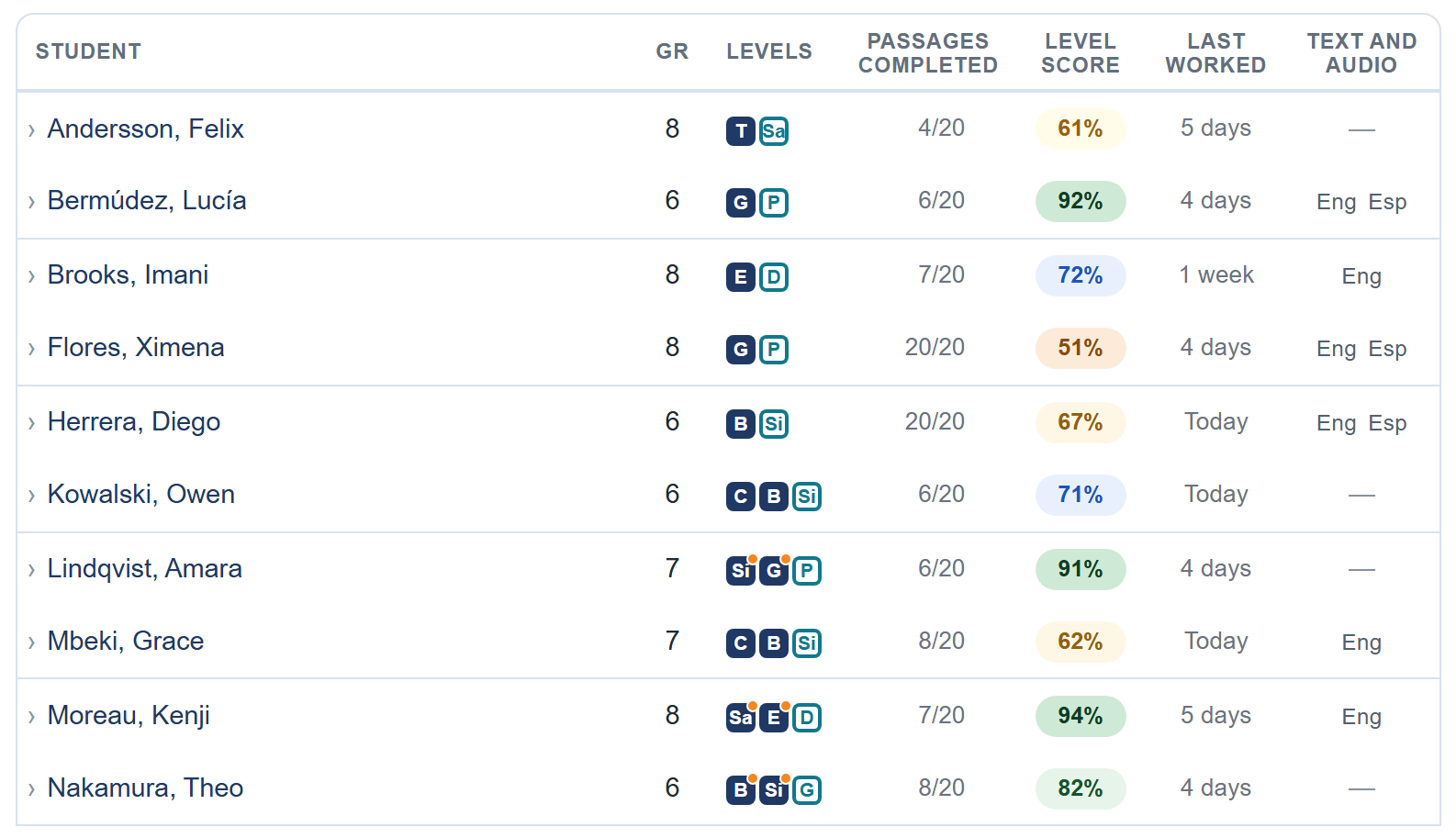
Every student's progress at a glance
The class dashboard is a snapshot of each student's progress, so you can see who needs your help. Click a student's name to open their Progress Letter, Certification Report or Passage History.
A short tour of the program
See how a teacher sets up a class, what students do on their first day, and what the reports show. Each video takes a few minutes, and together they are all the training a teacher needs to get started.
Student data stays protected
We collect only what the program needs to teach and report.
What we keep
- A student's name, grade and class, and the sign-in their teacher creates
- Their answers, scores and time spent
- The audio and Spanish settings their teacher chose
- All of it encrypted, on servers in the United States
What we never do
- Sell anyone's data, or use a student's data to market anything
- Show ads, or use analytics or trackers
- Give students an email address, or contact a student
- Keep student data on the device after sign-out
Designed to support schools' obligations under FERPA and COPPA. Everything comes from apply2succeed.com, so there is one domain to approve.
Help shape Apply2Succeed Reading
Use the full program free for the rest of the school year. We're inviting a small group of schools, districts and homeschool families to use it with their students. We believe their students will benefit, and we want to hear how it goes.
Study results never identify a student, teacher, school or district.
Free for the field test
Access to every level, every passage, the placement and growth tests, and the teacher reports, for the rest of this school year.
All we ask in return is your feedback.