Reports you'll actually use
Who is stuck? Which strand is weak across the class? What do I tell a parent? Every report comes from the same scored work, with nothing to grade.
What each report tells you
Results are organized by four reading strands, using your state's names. Beneath them sit your state's standards, with their codes.
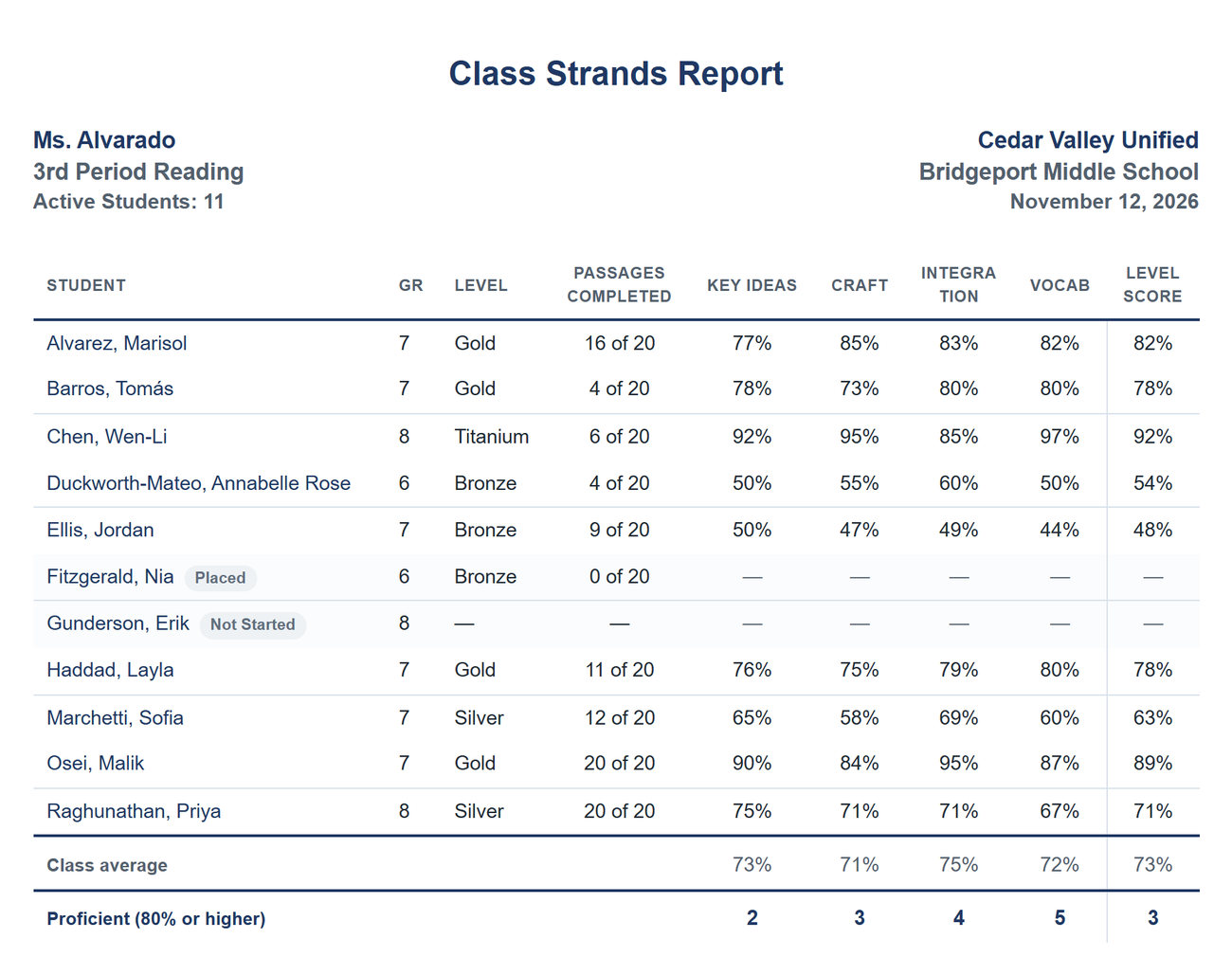
Class strands and standards
Shows each student's score on every strand and standard, with the class average for each, so you can follow everyone's progress at a glance.
See itCertification Report
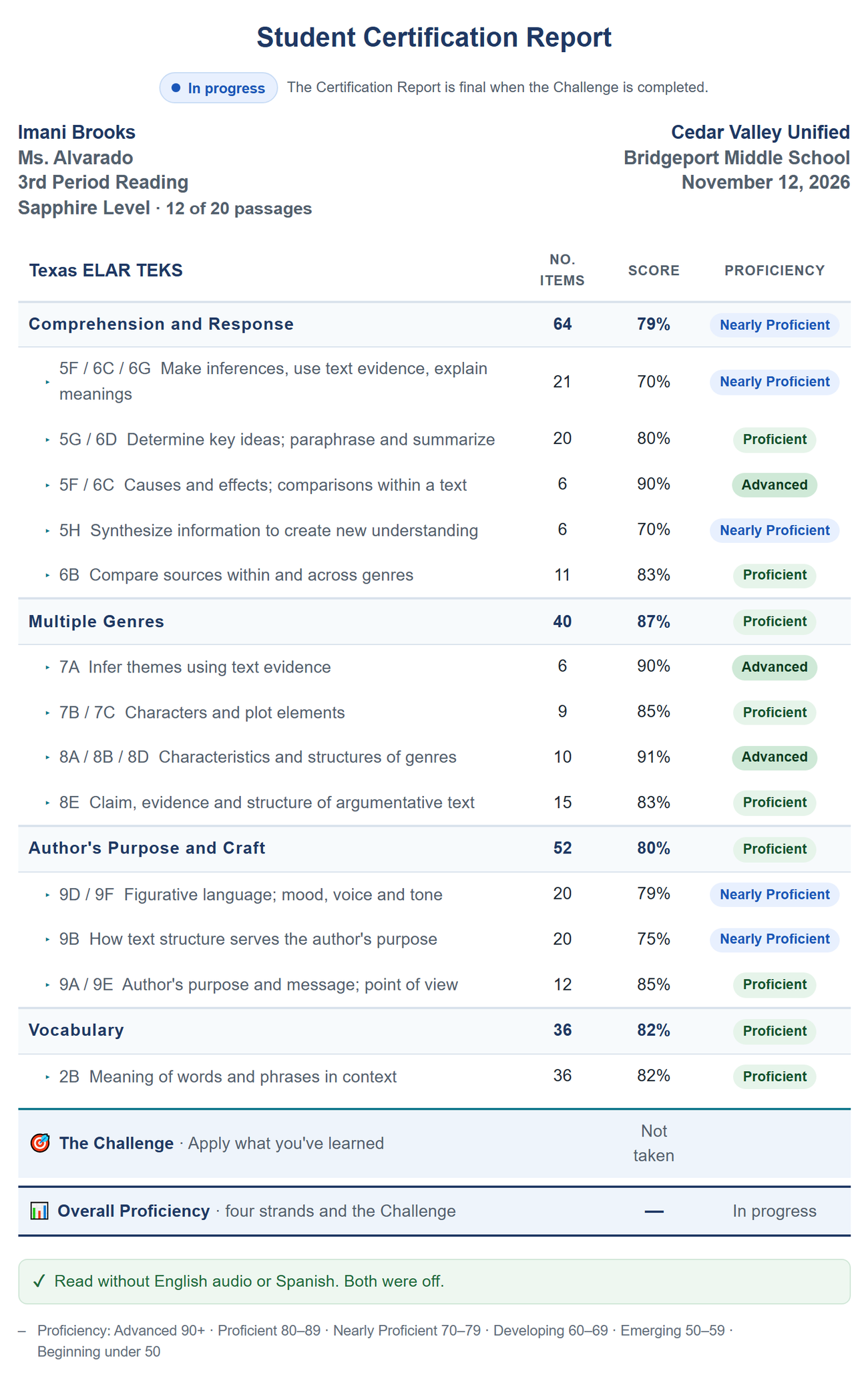
Certifies that a student has completed a level, with the evidence behind it: every strand and standard, the Challenge, and an overall proficiency.
See itPassage History
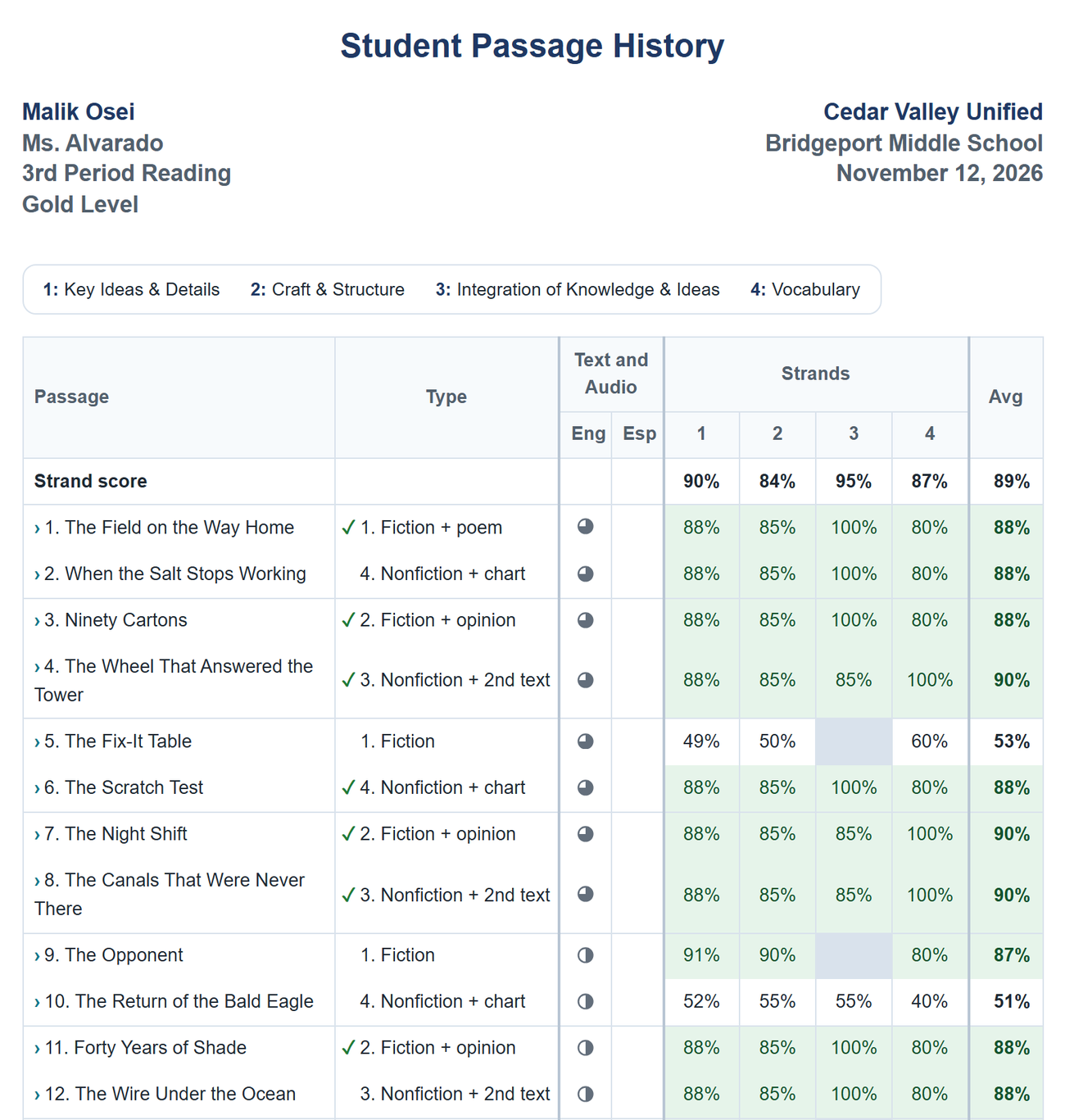
Shows how a student's scores are moving from one passage to the next, and opens any passage for its full report.
See itAudio and Spanish use
Shows how much each student used the audio and Spanish, so you can see whether a student is leaning on it less over time.
See where the class needs help
The class reports show each student and the whole class, by reading strand and by standard, so a weak spot, for one student or across the class, stands out.
Results in your state's own standards
When a student finishes a level, the Certification Report becomes their certificate, with distinction when the overall score, the four strands and the Challenge together, is 80% or higher.
The Certification Report breaks a student's level down by strand and by standard. A standard with only a few questions behind it is marked provisional.
Reports use your state's strands and codes, and a pre and post-test measures growth. The report shown here is printed with the Texas TEKS.
Every passage, with its score
Passage History lists every passage a student has read, with its score.
A Skill Booster is reported on its own, so it never affects a student's level score.
Student scores in plain language
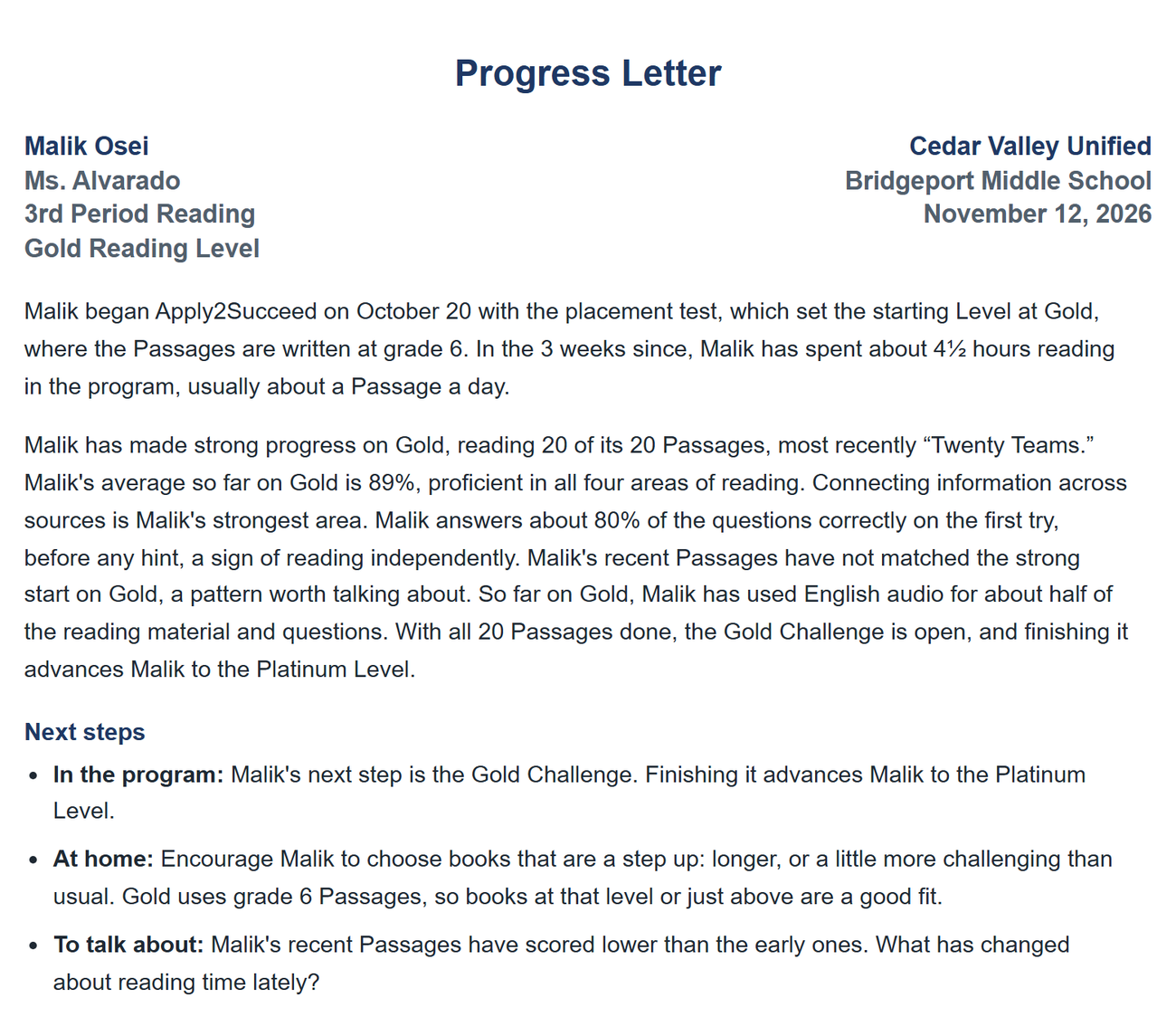
A letter home explains each student’s reading in sentences a parent can read, built from that student’s own results.
See these reports with your own students
The full program is free for the rest of this school year for schools, districts and families in the field test.