Personalized reading. Measurable progress.
A placement test finds your child's reading level. Engaging passages build comprehension and vocabulary, while reports show your child's progress.
What your child does
Your child reads a passage, often with a second source such as a chart or a poem, and answers sixteen questions about it. A wrong answer brings a hint and a second try, so each mistake turns into a lesson rather than a mark against them.
The passages run from a grade 3 reading level to grade 11, so a middle schooler who reads behind their grade, on it or well ahead of it works where they should, and moves up as they grow. If reading in English is hard, you can turn on English audio, which reads each paragraph and question aloud, or Spanish text and audio beside the English.
Each level ends with a Challenge: your child takes on a real role, weighs several sources and makes a decision they can defend. Strong work advances them to the next level early.
Your child sees only the level's name, such as Gold or Sapphire, and never a grade beside it.

You are the teacher
Your family is set up as its own home school, and you sign in as your children's teacher. Setting up takes one sitting; after that the program does the scoring and the reports.
Choose your password
Follow the link in your invitation and choose a password. Your state's reading standards are already set from what you told us when you joined.
Add your children
Create a sign-in for each child. They need no email address, and we never contact them.
Choose their settings
Turn on English audio, or Spanish text and audio, for any child who needs it, and see later how much they used it.
Let them start
Each child takes the placement test, then reads at their own level. Nothing is timed, and work saves as they go.
See how each child is doing
Three reports update as your child works: a Progress Letter that explains their reading in plain sentences, a Certification Report for each level they complete, and a Passage History with the score on every passage. You can print any of them.
Prefer to watch? Three short videos walk through setting up, what your child sees, and reading the reports. Getting started
A record you can keep
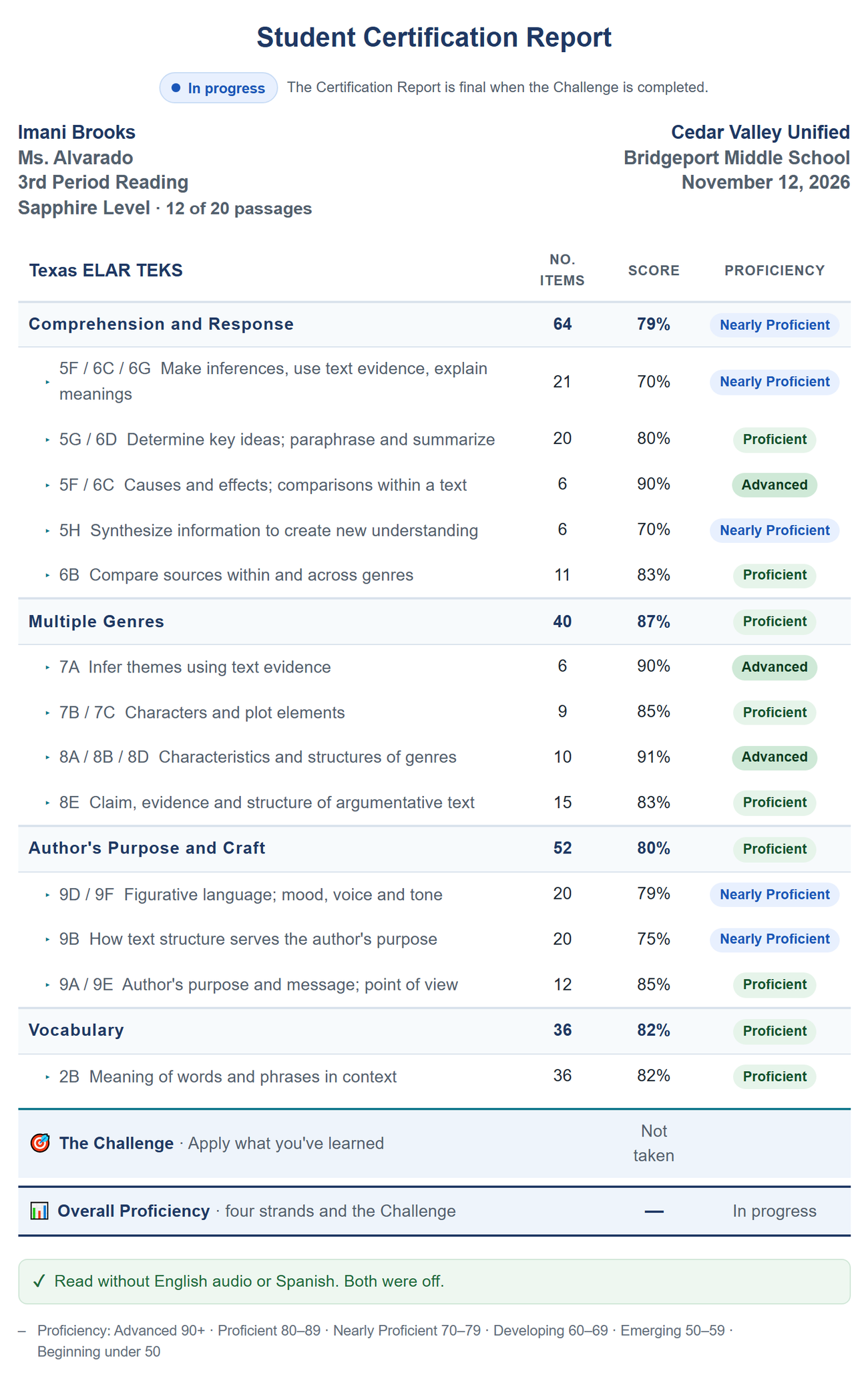
The Certification Report documents each level your child completes: their score in each area of reading and each reading standard, with your state's codes, their Challenge result, and their overall proficiency, completed when your child finishes the level. It serves as reading evidence for a homeschool portfolio.
The report shown here is printed with the Texas TEKS.
Several children, each at their own level
Each child is placed by their own test and works at their own level, so a sixth grader reading ahead and an eighth grader who needs more time can both use the program. You see them side by side, and each has their own reports.
Enroll up to five children in the field test. Have more? Tell us when you join, and we will set them up too.
Your family's data stays yours
Your children are visible to you and to no one else. There are no ads and no trackers, your children never receive email from us, and none of their data is kept on their devices after sign-out.
Questions families ask
What it costs
The field test is free for the rest of this school year. After it, families pay the same as schools: per child for each school year, and only for children who finish the placement test.
- Full year: $12 per child.
- Semester: $8 per child. A fall start runs from August 1 to November 30 and ends January 31. A spring start runs from December 1 to April 30 and ends July 31.
- Summer: $4 per child, starting May 1 to July 31.
- Account fee: $30 per family each school year.
Is it a full reading curriculum?
No. It supplements your reading curriculum: it builds and measures reading comprehension alongside the books and writing you already do.
How much time does it take?
A passage and its 16 questions take about 30 to 45 minutes, and two or three sessions a week keeps a child moving through a level. Work saves as they go, so a session can stop at any point.
Does it work for a portfolio or a state review?
The Certification Report and the Progress Letter serve as homeschool portfolio evidence: they show the level your child works at, their scores by strand and standard with your state's codes, and their progress over time. Both print.
What age is it for?
Middle schoolers. The passages run from a grade 3 reading level to grade 11, so a child reading behind or ahead of their grade works at the right level.
Join the field test as a family
Homeschool families are welcome in the field test, free for the rest of the school year. Tell us about your family and we will set up your account and send you an invitation. Signing up and paying online comes after the field test.
In the field test, your child takes the reading benchmark three times. The first is the placement test. The second comes one to three weeks after the start, and helps us check that every version of the test is equally fair. The third comes near the end, in week 14, and shows how much your child’s reading has grown.